Dr. Correa:
From the American Academy of Neurology, I'm Dr. Daniel Correa.
Dr. Peters:
And I am Dr. Katy Peters, and this is the Brain Health Podcast. Well, Daniel, we just celebrated Halloween and the Day of the Dead or Dia los Muertos. I never can pronounce it correctly.
Dr. Correa:
Dia de los Muertos.
Dr. Peters:
Thank you for correcting me. I hope you had more treats than tricks, or did you get trick-or-treaters? Did you dress up? What happened for Halloween for you?
Dr. Correa:
Well, I dressed up in my pajamas, and I went to bed early because it was the day before the New York City Marathon. So I did some things earlier in the afternoon. We are apartment building, because remember I'm in the city. We set up a trick-or-treat table, and different community members come by dressed from the apartment building in their outfits, and host the table and give out candies to the younger kids because it's earlier in the evening. And a lot of them stay there later, but I went upstairs to go to bed. And then we always kind of sneak some of our chocolate and pieces of candy for ourselves. I call it pre-nutrition for the marathon.
Dr. Peters:
Of course.
Dr. Correa:
So yes, that day mostly was me trying to wind down and get rest as much as possible so that I could feel great for my dress up and costume of showing up as a marathoner the next day. Normally I do love dressing up or maybe going to a party, but this was a night and a day for some more chill time for me. What about you?
Dr. Peters:
I love dressing up. I've been Wonder Woman, I've been Catwoman, which is pretty obvious. I've been Mother of Dragons from Game of Thrones, which was a huge fun one. We've dressed up the cats. I don't know. Do you dress up your animals? And what does Cookie dress up as?
Dr. Correa:
I'm not sure I would risk the integrity of my skin trying to dress up our cats. They are very cuddly when we let them be comfortable. But if we're trying to put too many things on them, yeah, the scratches would be too much. And Cookie has a pride flower that she wears on her collars all year round, but particularly highlighted for Halloween.
Dr. Peters:
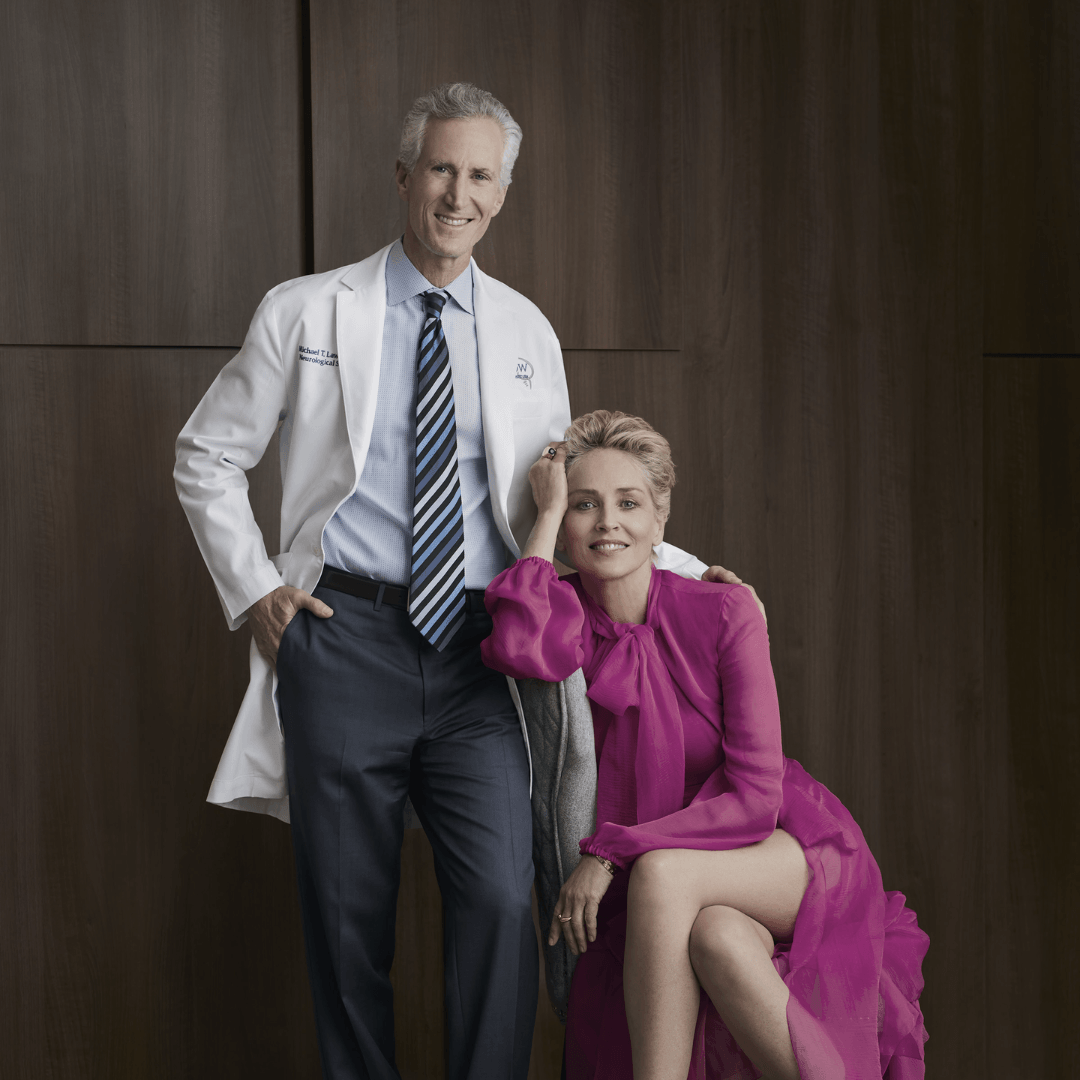
it's our favorite characters or iconic characters from movies and TV shows are commonly used as costumes. And we are speaking to someone who is known, I mean she's iconic herself, and known for iconic characters. It's Ms. Sharon Stone, award-winning actress, producer, humanitarian, whose career has just been truly amazing. And you know her from Basic Instinct, I mean Casino, recently Euphoria that was on streaming.
But you might not know that she's the survivor of a really rare neurologic condition called vertebral dissection. We spoke with her about her journey with this. She was joined by her own neurosurgeon, Dr. Michael Lawton, who is the president and CEO of the Barrow Neurologic Institute. We also then wanted to really delve in more about this rare condition. So we invited our vascular neurology expert, Dr. Parneet Grewal from MUSC to discuss vertebral dissection. So it's quite an episode.
Dr. Correa:
Yeah, I hope you guys enjoy it.
Dr. Peters:
Welcome everyone to the Brain Health Podcast. And today we're truly joined by a dynamic duo. Please join me in welcoming actress, amazing actress, Sharon Stone. Sharon is an award-winning actress, producer, and humanitarian whose career has inspired audiences around the world. You know her from Basic Instinct, Casino, and recently the streaming phenomenon Euphoria. But what you might not know is that she is a survivor of a rare condition called vertebral dissection and subarachnoid hemorrhage.
And the second part of this duo is her very own neurosurgeon, Dr. Michael Lawton. Dr. Lawton is the president and CEO of Barrow Neurological Institute, Robert F. Spetzler Endowed Chair of Neurosciences, and chair of the Department of Neurosurgery. Both are here today to elevate knowledge about vertebral dissection and subarachnoid hemorrhage and advocate for those recovering, living after these serious conditions. Sharon, I know it was a long journey that led you to get connected with Dr. Lawton. Before we get into what happened, could you tell us about how you and Dr. Lawton found each other?
Sharon Stone:
I started asking for them to please send me someone, anyone that was there in neurology that would listen to me. And Dr. Lawton was just graduated his internship, and I was like, "Hey, you got to talk to me. You got to listen to me. Someone needs to listen to me. Someone needs to tell me what is going on around here. And someone needs to talk to me about what my options are and what's happening to me. I'm hemorrhaging into my brain, and no one will talk to me and no one will tell me what's going on." And he talked to me.
Dr. Peters:
Great.
Sharon Stone:
And he was a human being. And he helped me and he told me what the new techniques were and what the new possibilities were, and what could happen and what they could do. And angiograms had just begun where an angiogram could happen, and they could go and look through my femoral artery and see what might be happening to me, and why I could be bleeding into my brain without sawing off the top of my head. And that seemed like a much more reasonable approach to put a camera up through my femoral artery instead of sawing off the top of my head. And I thought perhaps we should do that.
Because when I asked the doctor, "Well, if we saw off the top of my head, where does my head go? We're in earthquake country. What do you do with the parts of my head you saw off when you give me exploratory brain surgery?" And he said, "I don't have to tell you that." And I said, "Yeah, you do. You do. We're in earthquake country. I kind of want to know where my head is when you take it off." And he's like, "I don't have to answer these ridiculous questions." And I felt that he did. I felt that he did have to explain brain surgery to me and he did have to tell me what he was going to do with my head when he took it off.
Dr. Peters:
I agree with you completely. I think it really needs to be a communication and a great relationship with your doctor, especially a neurosurgeon. And I'm going to ask Dr. Lawton just the specifics. We know about Sharon's case. It sounds like it was very complicated. For people not familiar with the condition, can you tell us what was going on with her? What was the hemorrhage?
Dr. Lawton:
Sharon basically had what's called a subarachnoid hemorrhage. That's the fancy medical term for a leaky artery. In her case, it was a tear in the wall of her vertebral artery. And the arteries are built to be pretty strong, able to withstand the pressures and the stresses of blood flow, but occasionally they wear out, and they tear through the layers of the wall and they actually go through and through, and you have leakage of blood into the spaces around the brain. That's what the subarachnoid space refers to is the fluid-filled spaces between the brain and the skull where the brain resides. So she had that. She had what's called a vertebral artery dissection or a tear in the artery, a subarachnoid hemorrhage.
So she had this sudden severe explosive headache, went to the nearest community hospital to where she lived in San Francisco. As she mentioned, I was actually in San Diego at a neurosurgery convention. I had just landed. I was getting settled into my hotel when my resident called me. As Sharon also said, I was just a few years into my tenure there as an attending.
She called from the ER saying that she had a request to transfer Sharon Stone from this community hospital to UCSF, University of California San Francisco, where I was the attending. I said, "Oh my God, I'm not there, but let's help Sharon because she's an American treasure and we need to do everything we could possibly do for her."
And so we accepted her in transfer. She came to our medical center. We did some preliminary studies. We were looking for an aneurysm because, nine times out of 10, a bleed in that pattern, that subarachnoid hemorrhage pattern, is caused by a ruptured brain aneurysm. And our studies weren't showing a ruptured brain aneurysm. They were showing the blood, but not the aneurysm. So we had to do some more tests. We had to do an angiogram. We had to actually do another angiogram a few days down the road because our initial angiogram didn't reveal an aneurysm. With the gap of time, it became clear that that dissection or that tear was the culprit, and that's when we made the decision to treat this problem.
Dr. Peters:
Great. I'm glad that you found the right diagnosis because who knows what could have happened if they just assumed it was the wrong diagnosis. And Sharon, I think one of the things that you really shared in your story is you had a lot of really overwhelming things that happened to you all at once, and then after the recovery. What do you think made you so resilient other than I would say just thank you to Dior for giving you that wonderful contract and you did so much for them, but what do you think gave you the resilience to get through that and what would you share with others?
Sharon Stone:
I had a little baby when this happened. I had a one-year-old. And I was in such bad shape and I was months and months in bed. And finally he was up and he was walking and he was standing in my bedroom. And I remember he was standing there in his little onesie, and I was missing his infancy. And he was standing in my bedroom, and he looked at me and he said, "No more jammies, Mommy." And I realized I had to figure out how to get out of bed. I had to figure out how to stand up and get out of bed and take off my pajamas. I really had to figure it out. I had to get up, that I had a kid in his onesie telling me no more jammies. And that's a really big statement from a baby, and he meant it.
And I got up and I started sleeping on a mat next to his crib at night on the floor. Very shortly after that, I had another incident and I thought I was having another stroke. I had a really unbelievable pain that went across my head from one temple to the other. I raced to the emergency room at night. And we thought it was another stroke when I went there, but it wasn't. It was really terrifying and traumatizing.
But my kid, when it was happening, stood up on the side of his crib and held the bars and looked at me in the eyes and just screamed at the top of his lungs the entire time it was happening. He locked eyes and screamed the whole time it was happening. I sat up and he stood up and held the bars and screamed while it was happening.
And it was like he just decided to go through it with me. And there was something so peculiar and bizarrely bonding, and I just don't know how to explain it. I went to the hospital and I lived, and we just decided I would live. And my husband divorced me and took my kid, and made it really difficult for me to see him until he almost took complete and total custody of him until a point where I really didn't see him almost at all. And eventually, when he was 16, he moved back with me and he changed his name. And I don't know, it was just it was a very long and peculiar journey, but it was like this kid, this kid saved my life. I don't know how to explain it.
Dr. Peters:
I think you're doing a great job. I mean, that's a very poignant experience, and I'm just glad that you have somebody like that in your life. And I'm going to ask Dr. Lawton a question in that vein, when people are recovering from these really traumatic... I remember taking care of patients in the ICU with a subarachnoid hemorrhage, and it can be touch and go day by day, hour by hour, very, very serious. But really, what can we have for our family members and our loved ones to really help them recover? What do you see as sort of the recovery journey for people after they have these subarachnoid hemorrhages?
Dr. Lawton:
Well, the recovery journey is a long one. A ruptured aneurysm or a dissection like this that causes subarachnoid hemorrhage, it's a major insult to the brain. The brain is not meant to withstand arterial blood pressure. It's kept within arteries so that the brain is shielded from that pressure. So that when you have an event like a ruptured aneurysm and the brain feels that kind of pressure, it's highly traumatic.
And then after the initial insult, you then have the after effects. All that blood that gets into the spaces around the brain can be almost toxic to the brain, and cause things like vasospasm and brain edema or swelling, high pressures in the brain. These are the kind of immediate or acute issues that we have as part of the recovery journey to get patients through, and that-
Sharon Stone:
And it's so painful.
Dr. Lawton:
Yeah. The classic textbook description of this event is that when you ask a patient to grade the pain on a scale from one to 10, they say 12. They say something that's off the scale. And the classic headache comes on in an instant, which is, if you can imagine that pipe bursting, you go from normal pressures inside to these huge pressures inside in an instant.
Sharon Stone:
And it lasts for years. It doesn't last for a little bit.
Dr. Lawton:
Right. So the inflammation and all the trauma to the spaces around can cause that lingering headache. And so the journey begins by just getting through the treatment of the aneurysm. First, we secure the rupture site so that it doesn't re-bleed. Then we get through all the secondary problems like the vasospasm and the brain swelling.
Then patients who have cognitive or other neurologic deficits resulting from this whole event, we have to help them through that. And Sharon nicely described her issues with memory, which are very common. And that often takes the form of physical therapies or sometimes acute rehab and on and on. So what I tell patients is that recovery from a subarachnoid hemorrhage usually takes anywhere from six months to a year or beyond. In Sharon's case, that was exactly what we saw.
Sharon Stone:
Oh, there were things that took years to conquer.
Dr. Peters:
Really?
Sharon Stone:
Oh, yeah. I wasn't writing my own name for two years. And still, I can say still on occasion I'll have a slip. And there'll still be days where I'm not as sharp as other days. There are days where my memory is super, super, super sharp, and then there'll be days where I have little pockets of not quite as sharp.
Dr. Lawton:
I would say though that what I love about Sharon's story and her journey is that she's proven to the world that you can recover from this. You can pick up the pieces of your life, you can write a bestselling book, you can become an artist and paint, you can be a spokesperson for the disease and the cause. You can be an advocate for causes around the world. You can continue to act and be a model and to do all the things that she does so well. And to me, that's just the enduring message here is that even though it drags you through the valley of near death, you come through if you are strong and you just stick with it.
Sharon Stone:
I think it's really key to remember, we use, what, 10, 12% of our brain. So what you have to realize is that you have to work around, you have to work around the broken piece, and you have to actively think about how do I get around it? And there're blind parts we've never looked at. How do we go find the other 90%? How do we go find the part we never used before? How do we get that part to light up and how do we find that piece of ourselves we haven't used?
And there are parts of ourselves that people tell us aren't real, the psychic part, the sensing part, the understanding, the knowing mind. And I think we have to start relying on the knowing mind, particularly in women we know, we just do know, and we have to start leaning into the knowing mind. And when we do that, the rest of our brain starts lighting up.
Dr. Peters:
I agree, tapping into that knowing mind. I love that. And Sharon, we talk a lot about brain health here, and I think you're really touching on it, and sort of protecting our cognitive wellness. So what do you think, other than sort of tapping into that knowing mind, what are some of the most important things that you do to support your own brain health today?
Sharon Stone:
Well, I really eat correctly. I eat whole foods. I really eat and drink healthily. I make sure I sleep the correct amount of time. It's in my contracts that I get the right amount of time off so that I can sleep the correct amount of time. Eating, drinking, sleeping. We have to get all those healthy checkups all the time. And listen. And when you feel something is off, something feels funny on your body. God, my body, there's that little twick. It isn't feeling quite right. Keep going. And if the doctor tells you, "Yeah, I don't think so. I think you're hysterical." Here's what I know. Women aren't hysterical. The things we get blamed for are mirroring effects of men. We are not the hysterical ones. We are the logical ones. We are the ones that run that family. Why? Because we are the ones that can multitask. If someone tells you you're hysterical, get a new doctor.
Dr. Peters:
I agree. I agree with that.
Sharon Stone:
Do not listen to that malarkey. If you think something is wrong, guess what? Something is wrong. Find a new doctor.
Dr. Peters:
Sharon, you're preaching to the choir. I completely agree.
Sharon Stone:
Listen to yourself. I've had people tell me for three, four years that I was making up something wrong with me until my gallbladder was grown to my back and my kidneys and my side and was functioning at 18% because they didn't want to believe that a 39-year-old blonde, skinny white woman had gallbladder disease. And I'm scarred and all messed up because no one would believe me. I had five endometrial surgeries. People didn't want to believe that I had cysts the size of grapefruits. Oh no, I was hysterical. Forget it, man. Get a new doctor. Just forget it. Do not ever ease up. When you think something is wrong, demand attention. Demand attention.
Dr. Peters:
I love that message.
Sharon Stone:
You are not hysterical. You know what is going on. Demand attention. If you have a headache, go to the hospital. Don't brush it off, go to the hospital. Your minutes count. Minutes count in terms of you being able to recover.
Dr. Peters:
We often say time is brain, particularly in the world of vascular neurology. Don't you agree with that, Dr. Lawton?
Dr. Lawton:
Yeah, I do. I think that the time is brain slogan comes from thrombectomy and the blockage of arteries so that reestablishing flow is obviously critical. And I think the same's true with that classic headache that we were talking about. When you have what we call a sentinel brain hemorrhage from a leak from an aneurysm, sometimes that's just a precursor to the full-blown rupture. And so getting to the hospital is-
Sharon Stone:
I didn't get to the hospital for three days because I couldn't get anyone to believe me. It took me three days to get there when this started. It is everything. Just get to the hospital. Get to the hospital and get help.
Dr. Peters:
Yeah. Sharon, I often tell my patients to be a squeaky wheel, that I want to know-
Sharon Stone:
Absolutely.
Dr. Peters:
That I want to know everything. So even if you think it's not important, I want to know because it could be very serious.
Sharon Stone:
Be a loud squeaky wheel, throw a fit.
Dr. Peters:
I love that. I agree. And Sharon, but other than being a squeaky wheel and sort of letting people know what's going on with you, do you want to share anything today to our listeners about your recovery journey?
Sharon Stone:
When I was recovering, there wasn't much in terms of rehab. And all I can say is never stop rehabbing.
Dr. Peters:
I agree.
Sharon Stone:
Never stop working on your health. Never stop trying to get better. Never believe that this is as good as it gets. Never fall into, and never claim this is my stroke, my cancer, my heart attack. It isn't. It doesn't belong to you. It's not yours to claim. It's a stroke, a heart attack, a cancer that you're going to get rid of. Don't claim it. It doesn't belong to you. Let it pass. Don't claim it. It isn't yours. Let it go.
Dr. Peters:
Well, Sharon, I think you shared your journey with us, and I really appreciate it. You should be praised for your resilience. Dr. Lawton, thank you for also guiding us through this story and Sharon's story, and for being not only her doctor, but also her advocate.
Sharon Stone:
My hero and my friend and the person I trust the most. And if you ever need recovery or extra brain care, Dr. Lawton at Barrows Medical Center is the preeminent and most important neurological person in this country. And I've sent many people there, and I'm now on the board of this place. This is where it's at, the Barrows Medical Center. And it's connected with the Muhammad Ali Parkinson's Center. This is where it's at in neurological care in this country.
Dr. Lawton:
We've had a great long-term relationship. This happened in the early 2000s. It's now 25 years or so down the road. And Sharon, you've been great to us. I've had Sharon's kids out for research internships. They've stayed at my house. We've developed this relationship. Sharon calls me whenever something comes up or needs something. So I view our doctor-patient relationship as a real success story, and Sharon has reciprocated for supporting our Barrow Neurological Institute and our foundation. And this is just a great feel good story of a Hollywood icon who survives this incredible journey and gives something a little bit back to us. And we continue to give to Sharon in any way we can. It's just a wonderful thing.
Dr. Peters:
And thank you for giving all this time to us and to our wonderful listeners, and thank you.
Sharon Stone:
Well, you're doing something really valid and something that really works, and something that will save many, many people's lives. And we really, really appreciate you. Thank you.
Dr. Peters:
Brain health is for everyone. That's why we do this podcast, because no matter who and where you are, you should know what's going on in your brain.
Dr. Correa:
It's also why we're proud to be part of brainhealth.com. Cutting edge science, expert advice, powerful stories. There's something for every step of your brain health journey.
Dr. Peters:
Check out brainhealth.com and subscribe to free newsletters today. You'll become part of our movement of Brain Health for All.
Hello, everyone, and welcome to the Brain Health Podcast. Joining us today is Dr. Parneet Grewal. She is a vascular neurologist and stroke clinician researcher at the Medical University of South Carolina in Charleston, where she serves as an assistant professor of neurology and director of the stroke clinic. Dr. Grewal cares for patients with stroke and other cerebral vascular conditions, including vascular dissection, and we're going to delve into what dissection is.
Her research focuses on stroke recovery and rehabilitation, including the use of brain stimulation. Oh, interesting. As well as secondary stroke prevention. And she leads several clinical trials in these areas. She's also very passionate about community engagement and works closely with community partners to promote stroke education and awareness in the Lowcountry. Dr. Grewal, thank you so much for being on the Brain Health Podcast.
Dr. Grewal:
Thank you so much for having me. It's an honor here to talk about a subject that I'm very passionate about.
Dr. Peters:
Can you tell our listeners what the Lowcountry is? Because I don't know if everybody knows. If you aren't from our area, which she's one state below me, I'm in North Carolina, she's in South Carolina. Tell us about the Lowcountry.
Dr. Grewal:
Of course. Yeah. So I am actually in Charleston, South Carolina. So I'm joining you today from my office. I'm a stroke neurologist here. And Lowcountry actually refers to low lying coastal regions of South Carolina and parts of Georgia and does include Charleston. It is something that I did learn when I moved here.
Dr. Peters:
That's great. And there's so much great culture and food in the Lowcountry. I'm a huge fan of all the Gullah cuisine. This wouldn't be a good podcast, a good brain health podcast, if I didn't start talking about food. Because that's what my cohost and I tend to talk about. Now, for our listeners, you call yourself a vascular neurologist. Can you just describe what that is and what that means?
Dr. Grewal:
Yes. So as a vascular neurologist, what I focus on is cerebrovascular diseases, which does include stroke. So a vascular neurologist, or sometimes we refer to ourselves as a stroke neurologist, are neurologists who have done specialized training in cerebrovascular disorders.
Dr. Peters:
And it is so important. We recently talked about the BE FAST guidelines for stroke and how important that is. Today we're really going to talk about sort of a unique condition. But before we get into it, I'm just going to ask you, can you tell us about the blood supply of the brain? I've always loved the name of it. It's called the circle of Willis. Can you just tell our listeners, just remind them about how the vasculature of the brain is so unique?
Dr. Grewal:
Definitely, yes. So the circle of Willis, which you mentioned, it is basically a ring of blood vessels at the base of the brain. And as stroke neurologists, it is something we look at all the time on our patient's imaging scans. I usually describe it as a traffic circle for blood flow. It connects the circulation that is up in the front of the brain to the back of the brain and then right side to the left side. It becomes important, I think, for what we're going to talk about today, which is the vertebral arteries, because the vertebral arteries join together to form a basilar artery. So it forms the posterior part of the circle of Willis. And then the carotid arteries are the interior part and they are all connected.
Dr. Peters:
Yeah. I've always thought the anatomy of understanding that is just so interesting. Of course, I am a neurologist also, so we all like neuroanatomy. But to get into the nuts and bolts of what we're discussing today, what is a vertebral dissection?
Dr. Grewal:
So a dissection by itself, it just basically means that there is an injury or a tear to the wall of the artery. And in this case, we talk about vertebral arteries. So it is the artery that runs through the back of the brain, go up the neck, and supplies blood to the back of the brain. And what happens in a dissection is if there's a tear, the blood can actually get into the layers of the artery wall and it can cause what we call as intramural hematoma, which basically means that the blood is within the vessel wall. It is important because it can narrow or block that vessel or lead to what we can call an aneurysm formation. Dissection is important because it is one of the causes of the stroke that we think about in young adults.
Dr. Peters:
With Sharon Stone, she actually did experience this. And one of the things that she said, it was very difficult to initially diagnose her. Can you sort of tell us how this is detected, and when do you become concerned about this condition?
Dr. Grewal:
Actually, yes. So what you're saying is pretty spot on. So the symptoms of a dissection, especially vertebral artery dissection, are not sometimes obvious at first. People might report experiencing a very severe but unusual headache or neck pain, or symptoms like dizziness, which specifically is like a room spinning sensation, or nausea.
So these symptoms, some of these early symptoms, they're actually non-specific. They can happen with many different causes, which makes it a really hard to diagnose condition. And then these symptoms can actually proceed the more recognizable, you mentioned the BE FAST or the FAST acronym, which is sudden one side weakness, facial drooping, trouble talking. These non-specific symptoms can actually precede the actual stroke-like symptoms.
Dr. Peters:
And what do they do to detect the condition? Do you need to do special imaging? Is there a test that we use?
Dr. Grewal:
So the diagnosis and the detection, it really comes down to starting with the patient first, taking good history, doing a good exam. And then based on your history and exam, if you have high suspicion, getting the right imaging. If we are concerned about dissection, we usually get imaging, a CT or an MR angiogram, which looks at the vessels that supply blood up to the brain. And these studies can tell us if the vessel is narrow, blocked, or has other findings that can be suspicious for a tear in the vessel wall. And then this is how you initially diagnose this. Once you diagnose this condition and you have the acute management taken care of, then you kind of step back and think about why this happened. Then you do more tests to figure that out.
Dr. Peters:
And what are some of the risk factors? Are there certain people that are more predisposed to develop this?
Dr. Grewal:
Absolutely. So a dissection can be something that sometimes doesn't have one cause, and it can have a combination of factors. Some people do have an underlying vulnerability in their vessel wall, for example, with connective tissue disorders, or they may have certain anatomic differences that predispose them to have a dissection.
Other things that actually are associated with a dissection are things like high blood pressure, migraine, recent infection, and trauma to the neck. And when we're talking about vertebral artery dissection, a trauma becomes really important because sometimes even a very minor neck injury or trauma can lead to vertebral artery dissection. And there's something that I definitely want to end this question with is that it is really important for everybody to know that sometimes we don't figure out why dissection happened in the first place. There is not an obvious trigger and we can never identify why it happened. That is also common.
Dr. Peters:
I remember taking care of these patients, and the history, I agree with you, is so important. It's so important to listen to the patient because you can find maybe something in the history. But I agree with you. Sometimes you just don't find the cause, and that can be unsettling to the provider, but of course to the patient and the loved ones. Now once you diagnose this, what do you need to do for treatment? Because I'm sure there's like, this is the brain, this is a blood vessel, it's a critical need at this point.
Dr. Grewal:
Yeah. So the treatment really depends when does the patient come to the ER and what are their presenting symptoms? So if the dissection has actually caused a stroke, and they come really early into the ER, we can look at to see is there a clot? Is the patient eligible for the clot bursting medication? Has the clot traveled upstreams to the brain? And do we actually need to do a procedure called mechanical thrombectomy to take the clot out if the patient is suffering from an ischemic type of stroke, which is the blockage to the vessel wall. And then if the dissection has led to a bleed or a rupture, then the treatment is actually emergently repairing the vessel.
So those kind of decisions are really made hyperacute in the emergency room as soon as the patient presents. And then what happened after that, once we have stabilized, is you think about why this happened and how we can prevent it from happening again. A major concern, as I talked about, is that with a dissection or a tear, a blood clot can form. So we commonly use antithrombotic medications, which can either be anti-platelets such as aspirin, or anticoagulants. The choice really depends on the individual patient, their imaging, and their risk of clotting versus bleeding. And then overall, of course, we also look at patients, their overall health, do they have high blood pressure? Do we need to treat that high cholesterol and things like that.
Dr. Peters:
And I'm going to put you up on a pedestal, Dr. Grewal, because I think that vascular neurologists are some of the hardest working neurologists. Because the acuity of the situation is so key because you have these vascular events and you really have to act quickly. And to do that and to treat patients appropriately, first of all, you have to be very smart. So I bow down to you. I know a lot of wonderful vascular neurologists.
But you also have to have a great team and a multidisciplinary team. When you were describing just that treatment, I'm thinking of a neuro ICU person has to be involved, then maybe a surgeon, maybe an interventional radiologist. Can you sort of talk about your role as a team member to take care of these patients when they're really in a critical time?
Dr. Grewal:
Yeah, it's definitely a big team effort. Other than the neurologists, you talked about neuro critical care physicians, interventional neuroradiologists or neuroendovascular surgeons. And then most importantly are emergency room physicians who actually see the patient as they come in. It's definitely a big team effort. So I think our role as a stroke neurologist is, when the patient comes in, is to assess the patient emergently along with the emergency room doctors to get the appropriate imaging as fast as we can.
Usually the patient comes in, and all the hospitals have protocols. If there's a stroke alert, the patient rolls right to the imaging, the CT, the CTA, the patient rolls right there. And then based on what we find on the imaging, and after talking to the patient, we decide does the patient needs surgery? Does the patient needs the clot bursting medication? Does the patient needs neuro ICU level of care? It's definitely a big, big team effort.
Dr. Peters:
Yeah. My heart goes out to vascular neurologists. I think the world of them, I love working with them here at our institution and other institutions across the country. Now, you're involved with research for these disorders. What are you excited about in the field of vascular neurology that's sort of going to be up and coming, I guess, for patients with any kind of vascular disorder?
Dr. Grewal:
Yeah. No, definitely. So I think there are several really exciting areas about research. As a clinician researcher, I do spend a lot of time working in clinical trials and so forth, and coming up with a new treatment, innovative methods that we can do to actually help our patients.
Specifically for dissection patients, I think one thing is figuring out how we can better personalize treatment after a dissection. Do they benefit from antiplatelets? Do they benefit from anticoagulants? What are certain imaging findings that can help us make that decision? We're also learning why dissections happens in the first place. Is there any new innovative imaging that we can get to help figure that out?
And then the area that I am particularly interested in is stroke recovery and rehabilitation. That's where a lot of my research lives. I am interested both in post-stroke mood disorders and physical recovery because the goal, it isn't ultimately just recovery on the neurological exam. It's helping somebody get back to their life, their family, and the things that matter to them. And rehabilitation can be incredibly important in this.
So for patients, the surviving the initial event is only just beginning of their story. There is a tremendous amount of research going on in actually understanding how does the brain recover and how can we develop more individualized rehab approaches and study new ways to compliment the traditional rehab approaches we have to actually help them regain function and independence and ultimately helping them achieve the best possible recovery.
Dr. Peters:
Well, Dr. Grewal, for all of our patients with vascular disorders, I'm glad that you're there upfront, and for the long term, all the way through their journey. It's very exciting, and I really wish the best for all the patients with vascular disorders, including dissection. And thank you so much for being an amazing expert today.
Dr. Grewal:
Of course. Thank you so much for having me.
Dr. Peters:
Thank you for joining us today on the Brain Health Podcast. Follow and subscribe so you don't miss our weekly episodes.
Dr. Correa:
Also, for each episode, you can find out how to connect with our team and our guests, along with great resources in our show notes. We love it when we hear your ideas or questions. And you can send these in by email to podcast@brainhealth.com. Or leave us a message at 612-928-6206. I'm Dr. Daniel Correa connecting with you from New York City, and you can find me on social media @NeuroDrCorrea.
Dr. Peters:
And I am Dr. Katy Peters, joining you from Durham, North Carolina and online @KatyPetersMdPhD.
Dr. Correa:
But most importantly, thank you and all of our community members for letting us be part of your brain health journey. You make this podcast what it is. And by listening each week, you're helping us promote brain health for all.
Dr. Peters:
Before you start the next episode, we would appreciate it if you would rate us five stars and leave a review. That helps more people find us. And don't forget our website, brainhealth.com. Subscribe to receive our newsletters, and be a bigger part of our growing community. See you next week.