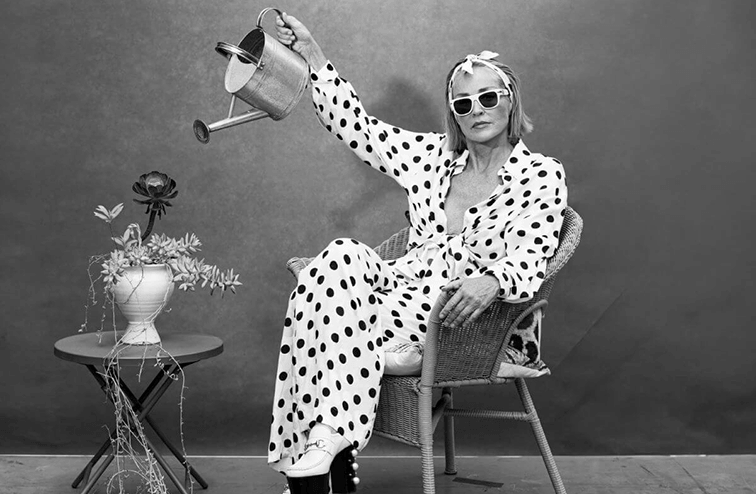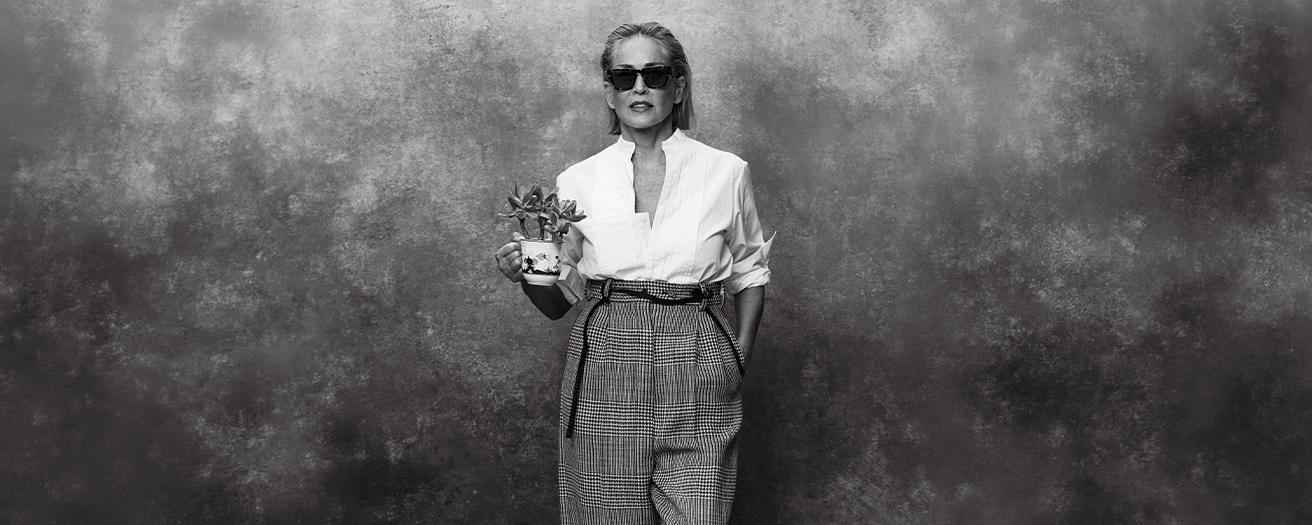
Twenty-five years after a tear in her vertebral artery that flooded the spaces around her brain with blood, Oscar nominee and Golden Globe winner Sharon Stone remains an avid protector of her own brain health. Sleep is written into the terms of any new role she accepts. "It's in my contract that I get the right amount of time off so that I can sleep the correct amount of time," she says. She avoids gluten and processed foods, is careful about what she drinks, exercises, and keeps up her checkups, as a critical maintenance program for a brain she knows remains injured. "We have to eat, sleep, maintain a disciplined system for our body," she says.
Even after 25 years, Stone does not see herself as healed, but as someone who has learned to live and work alongside an injury that never completely went away. "You have to work around the broken piece,” she says. “You have to actively think about, ‘How do I get around it?’ Never stop rehabbing. Never stop working on your health. Never stop trying to get better. Never believe that this is as good as it gets."
Stone first shared her story with us eight years ago. Now, at 68 years old, she shares how she continues to adapt to life after a subarachnoid hemorrhage—a stroke caused by bleeding in the space below one of the thin layers that cover and protect your brain.
"A subarachnoid hemorrhage is the fancy medical term for a leaky artery," explained Michael T. Lawton, MD, president and CEO of Barrow Neurological Institute in Phoenix, AZ. Dr. Lawton is the neurosurgeon who treated Stone at the University of California, San Francisco, and who has remained her physician and friend ever since.
"In [Stone’s] case, it was a tear in the wall of her vertebral artery." The vertebral artery is one of two major blood vessels that carry blood from your heart up through your neck to your brain and spine.
On that day in 2001, Stone was suddenly struck by a “lightning-bolt” like pain that felt as if she had taken a sharp blow to the head. That’s a key sign of trouble that should send anyone to the emergency department immediately, says Rachel Forman, MD, an assistant professor of neurology at Yale School of Medicine who specializes in stroke (she was not involved in Stone’s care). "Any time someone has a really severe headache that goes from zero to one hundred within seconds or minutes, that's concerning, and I would advise calling 911," she says. This is known as a thunderclap headache, and it can be a sign of bleeding in the brain. A headache that feels different from what a person has experienced before also warrants talking to a doctor.
In Stone’s case, finding the source of her symptoms took two angiograms several days apart. A cerebral angiogram is a catheter-based study looking at the vessels in the head and neck. "We were looking for an aneurysm, because nine times out of ten a bleed in that subarachnoid hemorrhage pattern is caused by a ruptured brain aneurysm," Dr. Lawton says. "The studies weren't showing a ruptured brain aneurysm. They were showing the blood, but not the aneurysm."
Initially, she had sought care at the nearest hospital to her home in San Francisco’s Sea Cliff neighborhood but soon transferred to UCSF Hospital, where Dr. Lawton, then a young neurosurgeon, came to her aid. He explained everything in simple language that helped Stone feel less overwhelmed. "He told me what the new techniques were and what the new possibilities were and what could happen and what they could do."
The initial recovery was long and arduous. "I was completely disabled. I couldn't remember anything at all," she says. "I'd lost my short-term memory. I'd lost everything. I had to relearn everything, how to walk and talk." The bleed also affected her right ear and right eye.
She was doing all of it, she says, while being treated by the people around her as if she were already gone. Her prognosis had been made public. "It was announced that I had a 1% chance of living," she says. She could not work, the legal bills mounted, and her bank froze her accounts for two years and she never recovered the money.
Her financial rescue came from the fashion industry rather than the film industry. "I got really lucky a couple of years later when Dior gave me a contract and saved me," Stone says. "Bernard Arnault, the head of Dior, gave me a skin care contract that was supposed to be for two years and ended up being for eight years. It kept me alive and got me back on track.”