Growing up with epilepsy in the family
The profound impact that his mother’s epilepsy had on Daniels is also not unusual. Clinicians increasingly describe epilepsy as a family condition, meaning it impacts the entire family.
“The unpredictability of seizures can create anxiety, uncertainty, and emotional stress for spouses, parents, siblings, and children,” says Dr. Hopp. Relatives become drivers, note-takers, and safety planners.
Dr. Katyal notes that roughly one in three family caregivers of people with epilepsy experience significant anxiety or depression, and many report disrupted sleep. Because many people with epilepsy can’t drive, they have to rely on family members for transportation, and job performance can suffer when caregivers miss work.
Children absorb more stress than they should. “Many grow up worrying about their parent’s safety,” Dr. Katyal says. “It’s common for children to learn seizure first aid at a young age and take on additional responsibilities.”
But Daniels doesn’t think of his childhood as a burden. Instead, he says it was an education. “It was very impactful on me and my family because it was something we couldn’t control,” he says. “But it gave me guidance. It gave me strength. There’s nothing I’ll face that’s harder than what my mom has been through.”
He credits a steady support system: His father, Carlton, a former basketball player who brought Daniels to the gym for 5 a.m. workouts in middle school; his siblings; family and neighbors who showed up when the household needed help. “I feel like we had a great supportive community,” he says.
Both Dr. Hopp and Dr. Katyal emphasize what children in Daniels’s position most need to hear—that epilepsy is a medical condition, and seizures are not anyone’s fault. It’s normal to feel scared. Seizures are treatable, and preparation can reduce fear.
They also recommend having a seizure action plan: a written document explaining what a person’s seizures look like, what to do when a seizure happens, when to give rescue medication, when to call 911, and their emergency contact information. Dr. Hopp suggests families practice their action plan “like a fire drill.”
Purple ribbons for epilepsy awareness
Although Daniels grew up with a supportive family and neighbors, he wishes more people understood what epilepsy is and how it impacts people living with epilepsy and their loved ones. He decided early in his life that he could do something about that.
November is National Epilepsy Awareness Month, and as a young child, Daniels began wearing purple socks to help raise awareness. The color purple has long been associated with epilepsy because the lavender flower has historically been seen to symbolize isolation, a feeling that people with epilepsy often relate to. Purple has also been seen to symbolize strength and dignity, which can represent the resilience of people living with epilepsy.
With this in mind, while attending Parkview High School in Lilburn, GA, Daniels gave his football teammates purple ribbon stickers to wear on their helmets. In his senior year of high school, he became vice president of Angels of Epilepsy—a role his mother had been describing to him since he was little. “She’s the one who mapped out the plan,” he says. “After her brain surgery, she wanted to do something rewarding for people who’d been diagnosed with the same thing she was.”
Angels of Epilepsy offers support groups, seizure first aid education, hospital outreach, and awareness events. Their mission is to make sure no one navigates epilepsy alone.
Daniels kept the work going in college, through four seasons at Liberty University, where he also organized a spikeball tournament for epilepsy awareness and had a campus tower lit purple.
But the big moment for Daniels came in 2024, during his football season at Louisiana State University (LSU). He asked his coach whether the team could do something for epilepsy awareness month. “You have to have the courage to ask those questions,” Daniels says.
His coach said yes. They decided to wear purple ribbon helmet stickers, which they wore in their game against Vanderbilt that November. The same week, Daniels and his mother co-hosted a seizure first aid training in the LSU football stadium with Epilepsy Alliance Louisiana.
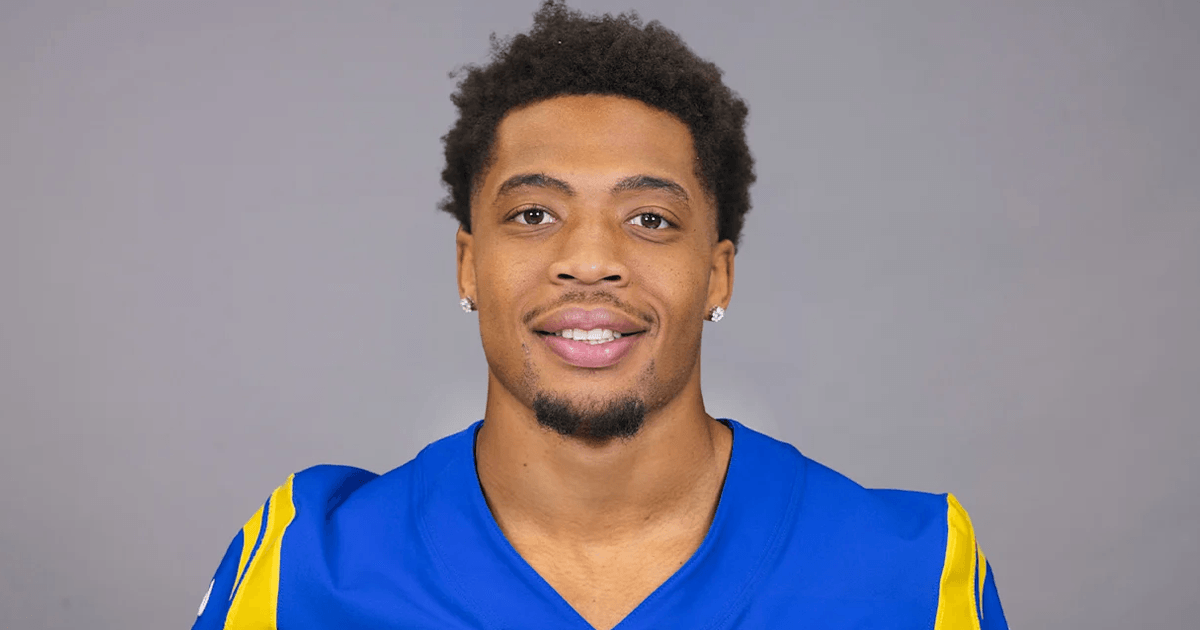
Daniels finished his college football career at the University of Miami, scoring seven touchdowns for a team that reached the national championship game. Then, during the 2026 NFL Draft, he became a Los Angeles Ram.
What’s next?
Now that Daniels has an even bigger platform, he’s brainstorming what he will do for epilepsy awareness month this November—maybe purple ribbons on helmets, maybe beyond just one team.
“I want epilepsy awareness to grow, and I really hope seizure first aid [education] gets put out there—not just through me, but the whole community, as many teams as possible,” he says. “I want this community to rise together.”
Daniels wants children growing up with a parent who has epilepsy to know they are not alone. “You can’t do it by yourself,” he says. “It’s about being around people who love you, who care about you, who will support you for a lifetime—not just in that moment.”
And two decades after finding his mom on the floor mid-seizure, he’s still by her side. “Seeing how far my mom has come gives me hope,” he says. “She’s my why. Every time I step on the field.”
Seizure first aid basics
The Epilepsy Foundation offers many resources for seizure preparation and safety. According to the CDC, if someone is having a seizure:
- Stay calm and stay with them
- Move hard or sharp objects away from them
- Put something soft under the head
- Gently turn the person onto their side so the airway stays clear
- Time the seizure
- Do not restrain the person and never put anything in their mouth—it is a myth that someone can swallow their tongue.
Call 911 if:
- The seizure lasts longer than five minutes
- Another seizure follows immediately
- It’s the person’s first seizure
- They’re injured or having trouble breathing
- The seizure happens in water
- They don’t return to normal afterward
Hear more from CJ Daniels
Listen as CJ Daniels shares his personal experience with epilepsy and what inspired him to become an advocate for people living with the condition on the Brain Health Podcast.