Comedian Rob Riggle raises awareness about veteran mental health
The actor and retired Marine Corps lieutenant colonel discusses the importance of seeking support and how his new film, Jimmy, brings veterans’ invisible wounds to the screen.
By Robert Firpo-Cappiello
November 24, 2026
Photo courtesy Rob Riggle
For two years, Rob Riggle was a correspondent on The Daily Show and an officer in the U.S. Marine Corps Reserve, which meant reporting for duty one weekend a month on the other side of the country.
"I was in NYC and I'd have to fly out to Miramar one weekend every month to study Clausewitz and the operational level of war, and I did that for two years," Riggle recalls. "I'd take the red-eye back to JFK on Monday morning and take a cab directly to The Daily Show with my luggage and go right back to work."
Riggle has balanced this lifestyle for most of his adult life. He retired from the Marine Corps in 2013 as a lieutenant colonel after 23 years of service, with deployments to Kosovo, Liberia, and Afghanistan. Along the way, he became one of Hollywood's most recognizable comic actors, with roles in Step Brothers, The Hangover, and 21 Jump Street.
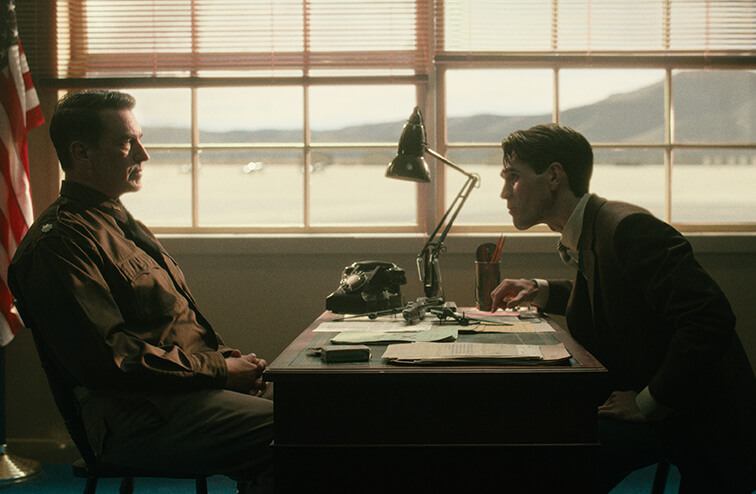
Now Riggle is bringing both identities to the screen. In the motion picture Jimmy, which opened in theaters November 6, 2026, he plays Colonel Terrill, an officer who figures in actor Jimmy Stewart's fight to serve in combat during World War II. The film tells the true story of how Stewart, fresh off an Academy Award for The Philadelphia Story, left Hollywood to fly bombers over Europe, came home utterly transformed from that experience, and found his way back through the role of George Bailey in It's a Wonderful Life.
For Riggle, a longtime advocate for veteran mental health, the film is a chance to talk about something veterans have carried home from every war, long before it had a name: post-traumatic stress disorder (PTSD).
Two careers but one mindset
When reflecting on his path from the Marines to television to film comedy, Riggle says, "It was a long road, many years of having more than one job. One of the nice things about being in the reserves is that you have time to pursue more than one career."
What he misses most is the Marines themselves. "I loved serving this country and I loved the Marines," he says. "There's an esprit de corps, an attitude, the way we approach things: 'Let's get things done and get them done right.' When someone told you they were going to do something, they did it, and you don't always get that in Hollywood."
That training also shaped how he looks after his own mental health. "There's a level of self-discovery as you go through Marine Corps training, the responsibility that's given to you at a very young age, and self-awareness is one of them," he says. "One of the first principles is know yourself and seek self-improvement. In hard times, I'm able to take stock of what's going on around me."
That wasn't always the case. "When I was a younger man, I didn't question things. I didn't ask any questions. I went on gut feeling, I went on instinct. I didn't pay attention if I was cranky or mad. I never thought to ask what's going on," he says. "You get wiser with age, I hope. You start to ask, why am I losing it here? Why am I not able to focus? What can I do to correct that? If you've been through something really hard, taking the time to assess it, to deal with it, process it."
When “pushing through" isn’t enough
Military training teaches perseverance, and Riggle values it. "There were many times when you'd be out in the [battle]field and you'd be absolutely miserable and there was nothing you could do about it except push through," he says.
But that instinct can become a trap. "Not just in the military but first responders too, the question is, when is pushing through not enough and you need to get help?" Riggle says. "We don't just need resources, we need the individual to seek them out. And what I have found is usually the individual, especially military, especially first responders, they're not going to put their hand in the air in front of their peers and say, 'I need help.' And it has to be made okay to do that."
Riggle is blunt about the difference between how things are supposed to work and how they actually work. "In theory, all these programs are available," he says. "But if you want to talk reality, that's different from what we all wish would happen."
Free brain health insights
Our email newsletters deliver tips, resources, and inspiration straight to your inbox.
A recent report from the U.S. Department of Veterans Affairs says that 7% of veterans experience PTSD. Research has shown that PTSD is a condition of the brain, not a failure of character. "There are genetic risk factors that increase the likelihood of developing PTSD after a major life event," says John Krystal, MD, director of the clinical neuroscience division of the VA's National Center for PTSD. He adds that alterations in brain structure, brain function, and brain chemistry are related to the persisting symptoms of PTSD.
The common symptoms of PTSD are re-experiencing, hyperarousal, avoidance, and negative changes in mood and thinking, says James P. Kelly, MD, FAAN, chief medical scientist at the Invisible Wounds Foundation, professor emeritus of neurology at the University of Colorado School of Medicine, and founding director of the National Intrepid Center of Excellence (NICoE). These four symptoms show up in daily life in recognizable ways:
Re-experiencing means unwanted memories of the trauma can surface at any time, often set off by a reminder such as a sound or smell. A person may have nightmares or feel as if the event is happening all over again.
Hyperarousal, sometimes described as feeling "keyed up," means being jittery, constantly on the lookout for danger, quick to anger, and having trouble sleeping or concentrating.
Avoidance means steering clear of people, places, crowds, or conversations that bring back memories, and sometimes staying busy so there's no time to think about what happened.
Negative changes in mood and thinking can include guilt or shame, difficulty trusting others, losing interest in activities once enjoyed, and feeling detached from family and friends.
Symptoms usually begin soon after a traumatic event, but they may not appear until months or years later.
For many service members, traumatic brain injury (TBI) often occurs with PTSD. TBI can cause headache, slow reaction time, poor attention span, difficulty concentrating, memory problems, and depression. "In the active-duty military and veteran population, the combination of these conditions is common," Dr. Kelly says. Because the symptoms are similar, sorting out which condition is causing what can be difficult.
The overlap is substantial. Two large reviews of the research found that between 37% and 48% of service members and veterans who sustained a TBI also had PTSD, and that military TBI patients were about four times more likely to develop PTSD than service members without a brain injury.
Sleep offers one clue. Both PTSD and TBI disrupt it, but in different ways. After a TBI, people typically fall asleep at night but sleep shallowly and wake often. "With PTSD, patients often have difficulty falling asleep due to a sense of loss of control or a fear of nightmares," Dr. Kelly says.
To tell the conditions apart, clinicians determine whether a brain injury actually occurred by asking what happened to a person's mental state at the time of a blow to the head, whiplash, or explosion. One frightening event by itself can trigger an acute stress reaction that later evolves into PTSD in some people. "There is data to suggest that [TBI] can increase the likelihood of developing a stress response, later leading to PTSD," Dr. Kelly says. Determining the cause of symptoms can be challenging— it could be TBI, PTSD, both, or neither. A medical professional can help determine the best treatment approach.
Jimmy Stewart’s invisible wounds
Stewart could have avoided combat entirely, Riggle notes. "Jimmy Stewart was an A-list, Academy Award-winning film star, and he could have opted out, gotten a deferment, taken a role that was more support-oriented," he says. "But he chose the hardest path possible, to be a bomber pilot, right into harm's way. He was an outstanding pilot and a great leader, and he wanted to put those skills where they'd be of the most use."
Jimmy portrays Jimmy Stewart struggling with what would now be recognized as PTSD, including angry outbursts on the set of It's a Wonderful Life. The real Stewart rarely spoke about the war with his children, according to his daughter, Kelly Stewart Harcourt, an executive producer of the film. But her mother told them that nightmares followed him home from Europe and lasted into the 1950s. He also struggled to eat after the war.
Combat missions in a B-24 bomber also put crews' brains at physical risk. At high altitude, crews depended on supplemental oxygen to avoid hypoxia, a dangerous shortage of oxygen to the brain. And explosions from anti-aircraft flak and shrapnel were sources of injury. "It is possible that blast-induced concussive forces caused brain injuries in some individuals nearest to the explosions," Dr. Kelly says.
Such "invisible wounds" were assumed to be purely psychological, called "shell shock" in World War I and "battle fatigue" in World War II. PTSD didn't become a diagnostic term until around 1980. "It is likely that mild TBI, [or] concussion, was commonly misdiagnosed as a psychological problem," Dr. Kelly says. "In fact, that still happens today in certain circumstances."
Riggle hopes Jimmy offers a more honest picture of veterans than Hollywood usually does. "Movies often show service members as either hardened or broken in mind and spirit for dramatic purpose," he says. "But the truth is they are all human beings, just a microcosm of society as a whole. Some people are incredibly strong, some get overloaded and overwhelmed and can be broken. Some people come back from a deployment with some PTSD and it doesn't prevent them from functioning. Some have a lot of trouble moving on, but we're doing a better job as a society in helping them."
PTSD treatment can help
The most recent VA/Department of Defense clinical practice guidelines recommend three trauma-focused psychotherapies, delivered one-on-one and following a structured, step-by-step treatment protocol: cognitive processing therapy, eye movement desensitization and reprocessing (EMDR), and prolonged exposure.
The guidelines also recommend three antidepressants: the selective serotonin reuptake inhibitors (SSRIs) paroxetine and sertraline, and the serotonin-norepinephrine reuptake inhibitor (SNRI) venlafaxine. The guidelines prefer psychotherapies over medication, Dr. Krystal notes.
New approaches are in development. Investigators in Dr. Krystal's division first identified the rapid antidepressant effects of ketamine roughly 30 years ago. Since that time, we have learned that, when combined with behavioral therapies, ketamine may help reduce the harmful impact of traumatic memories, Dr. Krystal says. The team is refining a blood test that may help predict which patients are most likely to benefit from ketamine. Still, there is no biological test for PTSD itself. "We are making progress, but there is not yet a test for PTSD," Dr. Krystal says.
For veterans with both PTSD and TBI, intensive programs show particular promise. At NICoE, a co-located team of specialists reviews each patient's records before admission, then provides individualized treatment daily for several weeks, handing off findings from one clinician to the next after each session. The model has been adopted by several VA and civilian programs. Such programs report significant and sustained improvement in physical, cognitive, emotional, and behavioral function, Dr. Kelly says. "More is accomplished in a short span of time by this immersion approach than with longer, traditional outpatient methods."
Research has also shown that the harmful effects of chronic low-level exposure to explosive blasts can accumulate over years of training and combat, even without a diagnosed concussion. The military is working to reduce blast exposure in training and to improve protective equipment.
Current Department of Defense guidelines require service members involved in an incident that carries a risk of combat-related TBI or concussion, such as a roadside bomb blast, to undergo mandatory screening and evaluation for symptoms. But symptoms don't always appear right away, and delayed-onset problems depend on service members and veterans recognizing them on their own. That's the gap Riggle worries about: the moment when someone needs to ask for help. Veterans with persistent symptoms who are concerned about their brain health can be evaluated at VA medical centers and at several civilian medical centers nationwide.
How friends and family can help veterans
Riggle believes friends, families, and fellow service members can help recognize problems early and encourage someone to seek support. "Everybody's got to pay attention, and that's hard because we're all in our own world, but we need to notice our colleagues, our friends, our loved ones," he says. "People get in trouble when they isolate, when they think they don't want to burden anyone with this trouble, when they don't want to appear weak."
Dr. Kelly hopes veterans and families understand that service can affect anyone's physical, mental, and brain health. Experiencing PTSD should not be assumed to come from a "flaw" or "weakness." "As a nation, we owe it to those who have served in the military to provide the proper concern, social support, and professional services they need," he says.
For his part, Riggle counts himself lucky. "I get to work mostly in comedy, which is a blessing because I get to laugh with very talented, funny people," he says. His advice to fellow veterans is the same principle that carried him from Miramar to the Daily Show set: "Once your service is over, find that new mission, getting back to that rigor you had in the service, that sense of purpose."
Read online at https://www.brainhealth.com/voices/celebrity-profiles/rob-riggle-veteran-mental-health-awareness/