
Emma Heming Willis on life after Bruce Willis's dementia diagnosis

After her husband was diagnosed with frontotemporal dementia, she learned to navigate caregiving while protecting her own health.

By Gina Shaw

September 22, 2026

Emma Heming Willis and Bruce Willis seated together outside in a natural setting.

Photo credit Belathée. Photo courtesy Emma Heming Willis.

As a child, actor Bruce Willis struggled with a severe stutter that was so debilitating it could take him several minutes to finish a sentence. But when he was cast in a school play, he found that the stutter completely vanished as he spoke his character’s memorized lines onstage. That discovery helped lead him to study acting at Montclair State University, where he received speech therapy to fully overcome the stutter. He would go on to a four-decade career as one of Hollywood’s top A-list actors, headlining movies such as Armageddon, The Sixth Sense, and the classic Die Hard franchise.

So when Willis, now 71, began having difficulties finding words several years ago, his wife, Emma Heming Willis, initially thought it was a return of that childhood stutter. “It was very subtle at first, but our communication wasn’t really there like it had been in the past,” says Heming Willis, New York Times bestselling author of The Unexpected Journey: Finding Strength, Hope, and Yourself on the Caregiving Path. “It was really language that I noticed first. But it never seemed to bother him. And never in my wildest dreams did I think it was a young-onset dementia that was surfacing.”

Early signs of frontotemporal dementia

Family has always been at the center of Willis’s life. He has three adult daughters with his former wife, actor Demi Moore, and two younger girls with Heming Willis, whom he married in 2009. The blended family has remained close. “Bruce has always been a very present dad, very present husband,” Heming Willis says. “He’s always said his most important role is one of being a father.”

But as that easy connection started to slip, beginning with his words, Heming Willis knew that something was wrong. And in fact, it wasn’t just an old stutter resurfacing—it was the first sign of a devastating neurodegenerative disease. Willis was eventually diagnosed with frontotemporal dementia (FTD), with its verbal-led form, primary progressive aphasia (PPA). That answer took time. “The first diagnosis that we received was aphasia, and it wasn’t until a year later that they landed on FTD,” Heming Willis says. “Aphasia was a symptom of a disease, not the actual disease.” The family received the full diagnosis at the end of 2022.

What is frontotemporal dementia?

Frontotemporal dementia is a term for several conditions, says David Clark, MD, associate professor of clinical neurology at Indiana University Health in Indianapolis. “Within frontotemporal dementia there are three major syndromes: the behavioral variant, semantic dementia, and progressive nonfluent aphasia,” he explains. “The aphasia form usually manifests early with word-finding difficulty, greater hesitation when trying to speak, or grammatical changes.”

Those changes can be easy to miss and sometimes appear first in writing. “You have a text message conversation with the person, and you realize they’re leaving out a lot of the simple function words,” Dr. Clark says. These are words like a, the, and, but, he, she, or we.

Gustavo Román, MD, co-director of the Nantz National Alzheimer Center at Houston Methodist Hospital in Texas, describes the same early pattern. “The main difficulty is that they start having problems finding the right word or remembering the name of a person that they have known for a while,” he says. As speech grows harder, Dr. Román offers patients a workaround. “When they just cannot come up with a way to put three or four words together, I tell them to sing,” he says. “When they sing, they’re able to speak a little bit better.”

The process of getting a diagnosis is long and difficult for many families, just as it was for Willis. “It can take an average of three to seven years to get to a diagnosis,” Heming Willis says. “It is underdiagnosed, it is misdiagnosed, it is not [noticed] enough in the doctor’s office. It can be attributed to a midlife crisis or depression or someone being bipolar.”

Part of the problem is that the people affected are often too young to fit the typical picture of dementia, so doctors may think of other conditions first. Dr. Clark says that recognition of young-onset dementia has improved in recent years and referrals now come faster.

Because an FTD diagnosis typically happens earlier in life than other dementias, families face additional burdens that aren’t a problem when someone is diagnosed with Alzheimer’s disease at 75 years old. “The biggest thing is that we’re taking people out of their work,” Dr. Clark says. “You take an individual who’s 55 and already reaching a point where they can’t hold down a job. Many of these people have children that are still in school,” he says.

Since the disease typically begins as early as the mid-40s, it often becomes noticeable at work, when patients have trouble with executive function. Executive function is the work the brain does to manage everyday tasks like making plans, solving problems, and adapting to new situations. “They make mistakes with the computer, they cannot text on the cell phone, they start having difficulty driving,” Dr. Román says. Unlike the short-term memory loss of Alzheimer’s disease, he says, FTD is primarily characterized by changes in language and behavior.

For the Willis family, the FTD diagnosis was hard to get. “I just always remember neurologists saying, ‘FTD, oh boy, that’s the one that you don’t want,’” Heming Willis says. “So then hearing it in the doctor’s office, it was like I could hear nothing else.”
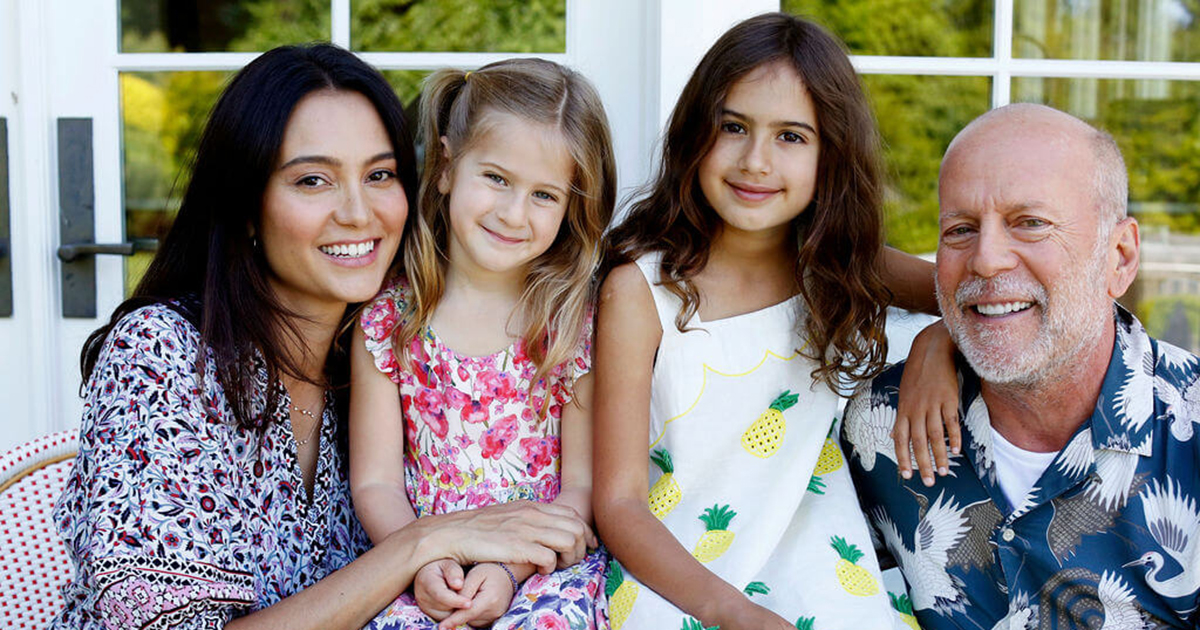

Emma Heming Willis and Bruce Willis pose with two of their children outdoors.
Photos courtesy of Emma Heming Willis

Caring for a spouse with dementia

What followed was uncertainty. “We were sent away with really no support, no roadmap. It’s kind of a ‘Well, here’s the diagnosis, and just check back in a couple of months.’ It was a really traumatic time for us,” she says. “And that’s not just our story. That is so many people’s stories, that at that diagnostic appointment, it’s really a diagnosis and good luck, because there really aren’t treatments.”

Dr. Clark says that gap reflects how few tools exist. “From a pharmacological standpoint, we have so much less than what we have for Alzheimer’s disease,” he says. For the language-led form, “pretty much nothing has been shown to be effective,” which can leave clinicians little to offer beyond a referral to a social worker or to the Association for Frontotemporal Degeneration. “It doesn’t surprise me that patients feel that they’re kind of given a handshake and told, ‘I’m sorry about this, good luck with it,’” he says.

With no clear guidance, Heming Willis created her own approach. She found dementia-care specialist and occupational therapist Teepa Snow, whose book Understanding the Changing Brain helped her grasp what was happening. “It allowed me to understand what a healthy brain looks like versus what a brain looks like that has a disease,” she says. “And it helped me learn how to separate my husband from his disease, to understand that what he was doing was not on purpose.” That shift, she says, brought back “so much more compassion and patience and empathy.”

Dr. Román tells families something similar but, often in blunt terms. “This is not the nice guy that you married 20, 30 years ago,” he says. “Don’t take it personally.” As FTD spreads beyond the brain’s language centers, behavior often changes too. Patients may withdraw, lose their inhibitions, or develop compulsions, features that are more prominent in the behavioral variant of the disease. “Sometimes they have no control. They eat like crazy,” Dr. Román says. Those symptoms make FTD one of the hardest dementias to manage at home, he adds. “These patients also react very poorly to the usual tranquilizers and antipsychotic medications.”

Dr. Clark describes a similar range of behaviors. “People say or do things that they never would have considered saying or doing in the past.” Others develop fixed food compulsions. “Patients want to eat ice cream for every meal, or if they get a box of cookies, they can’t stop eating the cookies until the cookies are gone,” he says. “Those can be hard on a caregiver, and especially a spouse.”

Understanding the disease changed how Heming Willis sees her husband. She pushes back on the idea that dementia strips a person of dignity, quoting Ms. Snow: “Dementia doesn’t rob someone of their dignity. It’s our reaction to them that does.” There is grief, she says, but not only grief. “There is still so much joy and so much laughter to be had, along with the grief and the sadness of it.”

Balancing caregiving and parenting

Heming Willis’s two daughters were 8 and 10 when Willis was diagnosed; they are now 12 and 14. Heming Willis worked with a child-life expert to learn how to talk with them. “It’s very important to be honest,” she says. “Give them the truth in age-appropriate terms.”

She used to bristle when people called children resilient. “I’m like, ‘I don’t think you really grasp how hard this is,’” she says. “But it is absolutely true. They’re also looking to us adults to see our resilience in this.” What the girls see, she says, “is how we show up for the people that we love. And that’s the silver lining.”

One of the hardest decisions came when the family arranged a separate home where Willis could receive specialized care. “It is a very difficult decision that does not come lightly,” Heming Willis says. “There’s a lot of guilt and shame that is so heavily embedded in that.” But the move let her step out of crisis mode. “I get back to being in my original role, and that is being his wife,” she says. “I now get to just be present with my husband and hold his hand and talk with him and have that connection, which I didn’t have prior.”

To other families considering memory care or a similar move, Heming Willis offers support and understanding. “Sometimes, depending on the family and circumstances, these decisions are the right decision,” she says. “If you feel that you have come to that point in the journey, that it’s time to make that change and shift, then that is the right move. There should be no shame in that. It doesn’t mean you’ve failed as a caregiver. It means the disease is asking for a different kind of care and support. That is a true act of love.”

Families should not be judged for reaching that point, Dr. Román agrees—nor should they second-guess themselves. “They have to realize they cannot take care of the patient. The care that needs to be given requires someone who specializes in this.”

Brain health for caregivers

Heming Willis has become an outspoken advocate for caregivers, partly because she went through a long period of neglecting her own health.  She had skipped her mammogram and her annual checkup, something that’s common among caregivers, she says.

Then a neurologist told her about the toll caregiving takes, including how often caregivers die before the people they are caring for. She learned that dementia caregivers also face a higher risk of cognitive decline themselves, because they are dealing with stress and sleep disruption, depression, and social isolation. “That was a wake-up call,” she says. “She gave me permission. I wasn’t a failure because I needed support.”

She now sees caring for her own brain health as part of the work involved in caring for her husband and describes using evidence-based strategies like the Mediterranean diet, sleep, movement, and human connection. “When I care for myself, I think about, what have I done for my brain today? Because when I care for my brain, the rest of my body benefits,” she says.

In March 2026, she launched the Emma & Bruce Willis Fund for Dementia Research and Caregiver Support. Its first grant went to the Association for Frontotemporal Degeneration, split between respite for caregivers and FTD research. “This just feels very meaningful and hopeful,” she says.

Both Dr. Clark and Dr. Román urge families not to dismiss warning signs. “When patients start having this difficulty with finding the right word, you need to pay attention…they need to see a neurologist,” Dr. Román says.

Heming Willis knows how isolating the life of a caregiver can be. "So many caregivers are doing this solo, by themselves, without support, and we really need to change that,” she says. “This is not a solo mission," she says. "The sooner that you can put that structure in to be able to have family and friends be a part of this journey, the better it will be for everyone involved. We really want caregivers to feel not just seen but supported."

More from Emma Heming Willis

On the Brain Health Podcast, Emma shares her family's experience following her husband Bruce Willis's frontotemporal dementia (FTD) diagnosis and discusses her mission to help caregivers find support while prioritizing their own well-being.